PG&E Energy MCP
Solar + Battery Intelligence
Overview
Upload your PG&E energy data. Have a conversation about it. Get real answers — the right rate plan, the right system size, the right battery strategy.
28 domain-informed tools encoding the full complexity of PG&E billing — rate schedules, CCA vs. bundled providers, PCIA vintage charges, NEM 2.0/3.0 export credits, time-of-use windows, and income tiers — so Claude gives accurate, personalized answers instead of hallucinating rates.
Also: Powerwall Control
If you have a Tesla Powerwall, the tool reads live status and controls your battery directly — switch modes, adjust reserve, enable grid charging, optimize dispatch. All through natural language in Claude.
Nobody knows what they actually pay per kWh
PG&E billing is extraordinarily complex. Your effective rate depends on your rate schedule, provider (bundled PG&E vs. Community Choice), PCIA vintage year, NEM version, time-of-use period, and income tier. Rates change roughly twice a year, and CCA rates change independently.
| Problem | What happens |
|---|---|
| Hallucinate rates | Doesn’t know EV2-A winter off-peak is $0.20635 for a PCE 2016-vintage customer |
| Confuse CCA vs. bundled | PG&E bills show delivery rates, not total. Real formula: delivery + CCA generation + PCIA |
| Guess NEM 3 values | The Avoided Cost Calculator has 288 hourly values ($0.025–$0.28). AI guesses "$0.08" |
| Miss TOU differences | EV2-A peak is every day; E-TOU-D is weekdays only. Wrong windows = wrong math |
| Break true-up math | NEM credits accumulate monthly and settle annually. The true-up IS the bill |
Upload your data. Ask a question.
Download your Green Button data and latest bill from PG&E. Upload both to Claude. The tool takes it from there — detecting your solar system, asking about your battery, comparing rate plans, and finding where you're leaving money on the table.
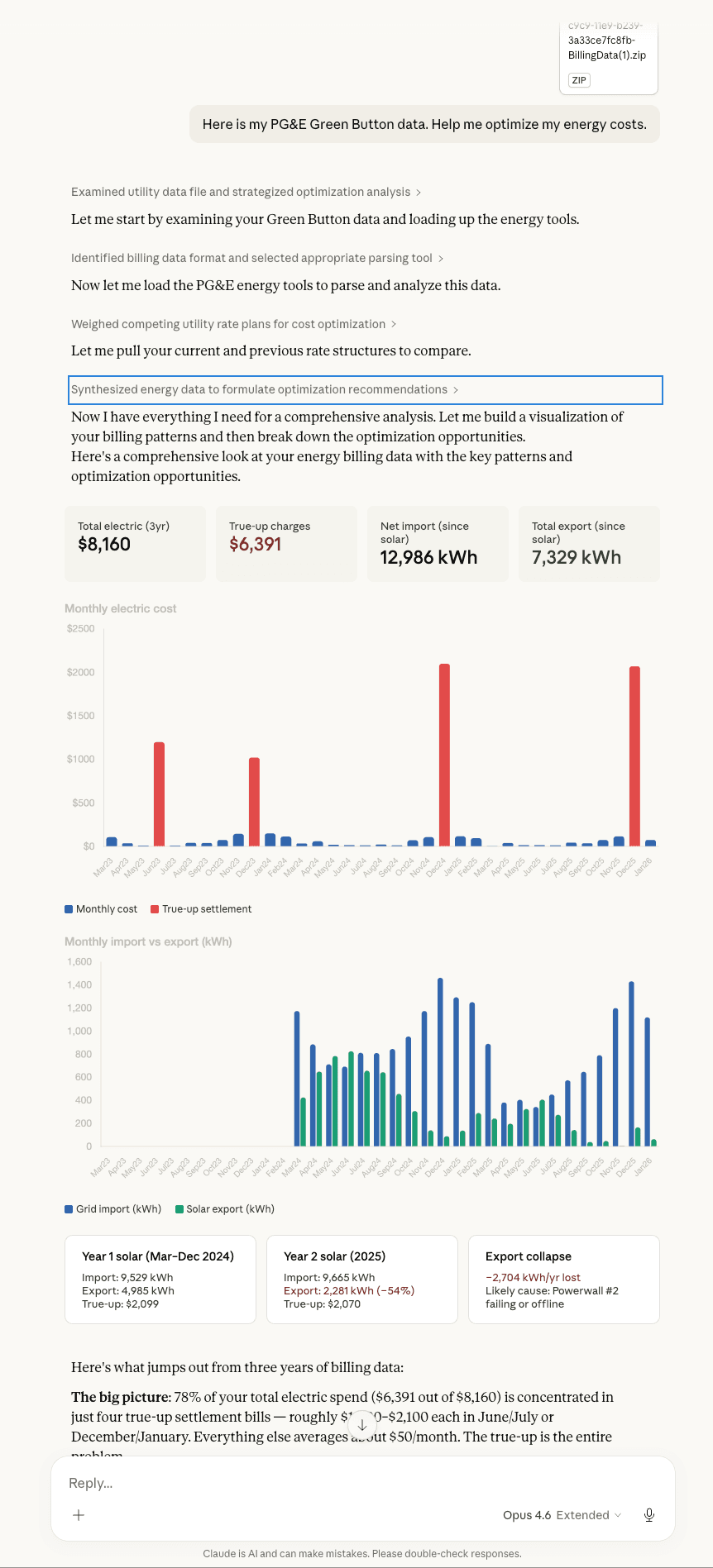
Upload your Green Button data and bill — get rate comparisons, usage breakdown, and actionable recommendations
28 tools, four layers
Data ingestion that handles multiple formats, analysis tools for understanding your energy usage, Powerwall control for managing your battery, and a rate engine encoding the full complexity of PG&E billing.
Ingestion5 tools
Parse every data format a PG&E solar customer might have
Analysis8 tools
Energy usage analysis, rate comparison, and optimization
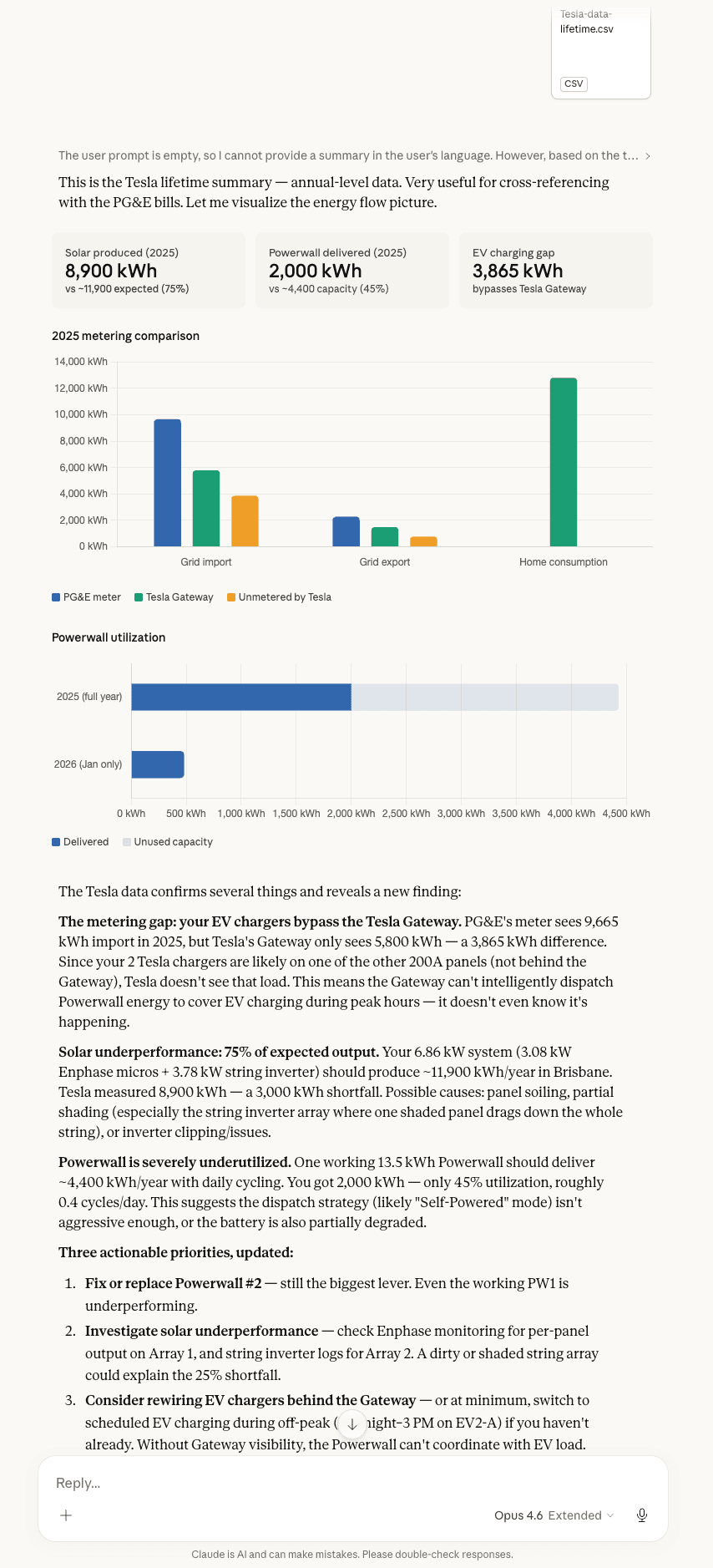
Add Tesla data for battery performance analysis, solar production tracking, and dispatch optimization
Powerwall6 tools
Live battery status and direct control via Tesla FleetAPI
Rate EngineThe hard part
All rates verified against PG&E tariff sheets effective March 2026
| Schedule | Peak Window | Peak Days | Best for |
|---|---|---|---|
| EV2-A | 4–9 PM | Every day | EV owners, battery systems, heat pumps |
| E-ELEC | 4–9 PM | Every day | All-electric homes |
| E-TOU-C | 4–9 PM | Every day | Default residential TOU |
| E-TOU-D | 5–8 PM | Weekdays only | Shortest peak, weekday-only |
Connect in 30 seconds
PG&E Energy Analyzer runs as a live MCP server. Connect it to Claude right now.
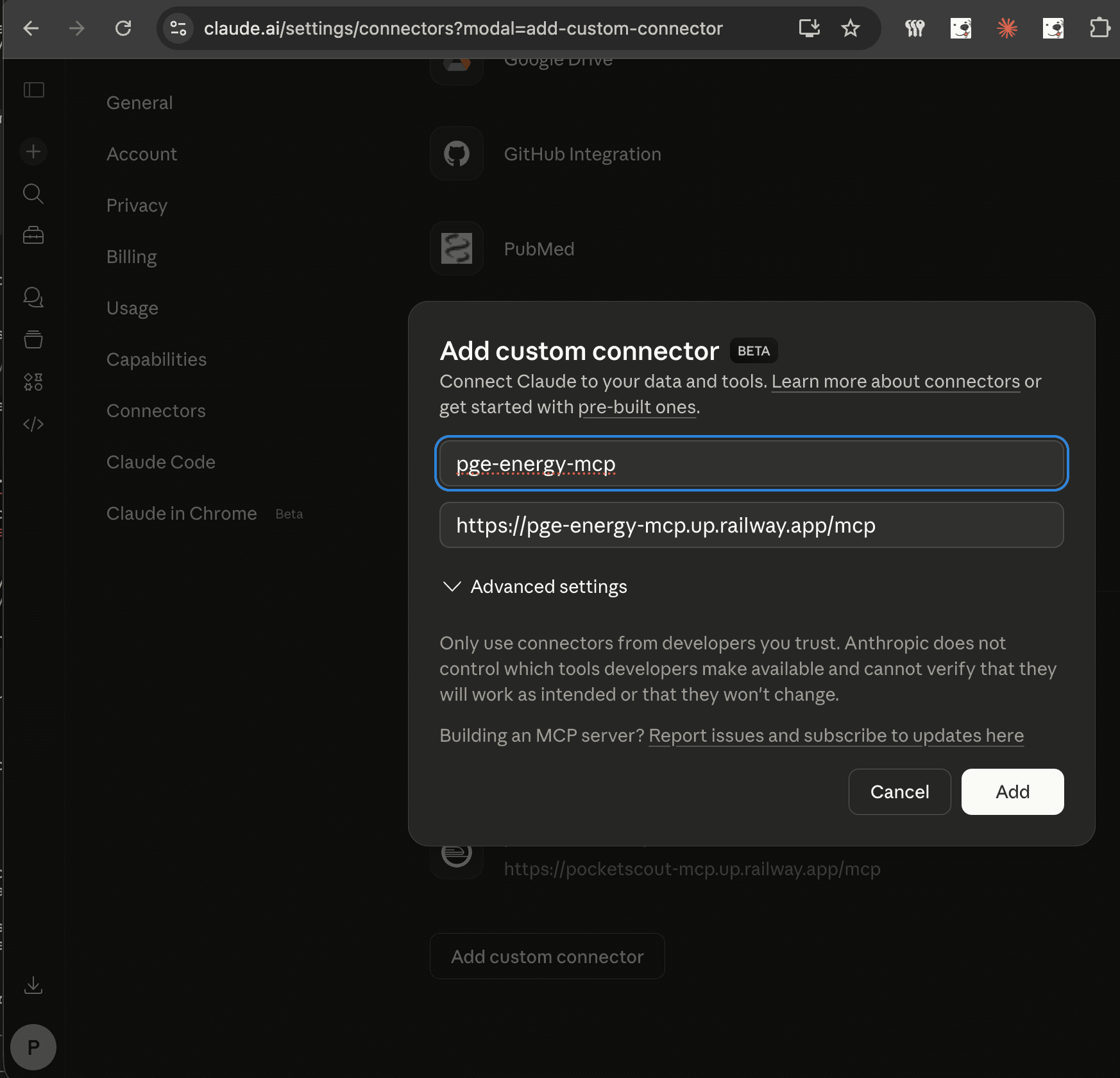
“Here is my PG&E data and latest bill. Help me optimize my energy costs.”
Upload your Green Button CSV and bill PDF. The tool walks you through everything.
Built from personal frustration
This project started when I realized I had no idea what I was actually paying per kilowatt-hour — and neither did my solar installer. I read every PG&E tariff sheet, decoded the CCA billing structure, mapped the PCIA vintage system, and built the rate engine to make sure nobody else has to do the same detective work.
The Powerwall control layer came from wanting to actually act on the analysis — not just know the optimal dispatch schedule, but execute it. And the battery optimizer uses mixed-integer linear programming (Pyomo + CBC) because energy arbitrage with TOU rates, NEM credits, and reserve constraints is genuinely a hard optimization problem.
Like PocketScout, the design philosophy is the same: the gap in the MCP ecosystem isn't more API wrappers. It's domain expertise encoded into tool design — the rate engine that knows EV2-A winter off-peak is $0.20635 for a PCE 2016-vintage customer, the battery optimizer that understands NEM credits accumulate monthly and settle annually.