
PocketScout MCP
Binding Site Intelligence
Overview
An open-source MCP server that aggregates structural, chemical, and literature data to evaluate druggable binding pockets on protein targets — filling the gap between “I have a target” and “I'm running RFdiffusion.”
Six domain-informed tools compose across five public APIs (UniProt, RCSB PDB, AlphaFold DB, ChEMBL, PubMed) to give Claude the scientific knowledge it needs to reason about binding sites, ligand history, cross-species conservation, and recent literature.
What is MCP?
Model Context Protocol (MCP) is how AI assistants connect to external tools and data sources. PocketScout provides six specialized tools that give Claude capabilities it doesn't have natively — the ability to query protein databases, assess binding site druggability, and evaluate competitive landscapes in real time.
The gap between target and design
Before any computational design work begins, scientists spend hours to days manually gathering information across half a dozen browser tabs. They check UniProt for protein function, browse PDB for structures, search ChEMBL for prior art, read papers for allosteric insights — then synthesize it all in their heads.
This reconnaissance step is where campaigns quietly go wrong. A scientist picks the obvious binding site without checking that 200 compounds have already failed there. They miss an allosteric pocket described in a recent paper. They don't realize the binding site residues aren't conserved in mouse until their in vivo model fails six months later.
The life sciences MCP ecosystem is thin — most servers are hackathon-quality wrappers around REST APIs with no error handling, no scientific context in the tool descriptions, and no thought about how tools compose into real workflows. The ecosystem has plumbing. What it lacks is domain expertise.
Tool descriptions as prompt engineering
Claude selects and sequences tools based on their docstrings and parameter descriptions. Every description in PocketScout encodes scientific reasoning — not just what the tool returns, but when to use it, what the results mean in context, and how they gate downstream decisions.
Six tools, one assessment
Built on FastMCP 3.0 with async API clients for UniProt, RCSB PDB, AlphaFold DB, ChEMBL, and PubMed. Each tool queries one or more public APIs and returns pre-interpreted, LLM-ready results.
characterize_targetget_related_structuresget_binding_sitesget_ligand_historycheck_conservationsearch_target_literaturebinding_site_assessmentWhat I chose not to build
The hardest design decisions in PocketScout were about what to leave out. Each decision reflects a principle about what MCP tools should and shouldn't do.
Connect in 30 seconds
PocketScout runs as a live MCP server. You can connect it to Claude right now.
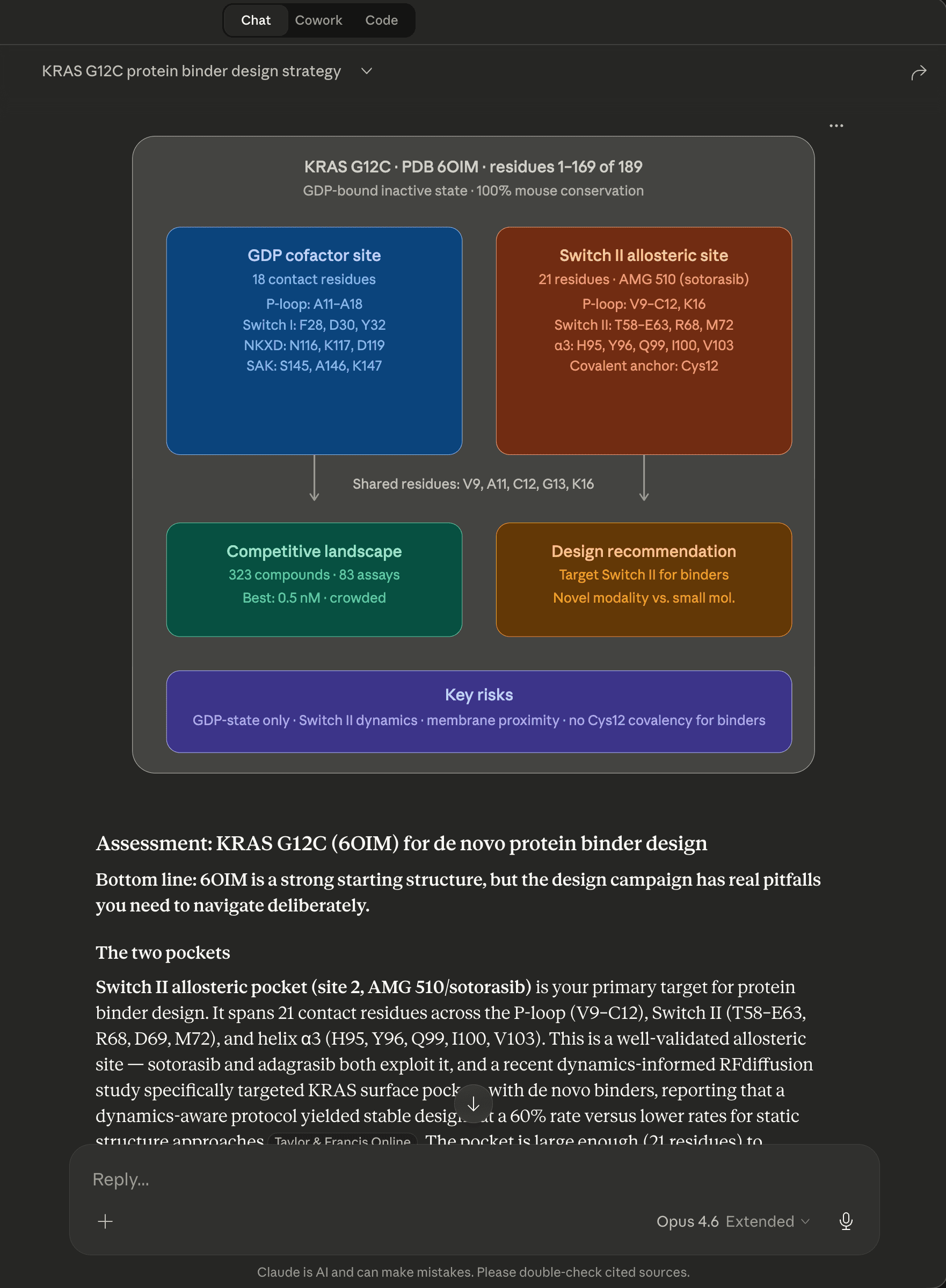
PocketScout assessment of KRAS G12C (PDB 6OIM) running in Claude
Where PocketScout wins
Prompts where live data, coordinate-level computation, or current database queries matter — not general knowledge.
“Assess the binding landscape of PDB 8QXB for designing a protein binder to block viral entry.”
Claude won’t know structures deposited after its training cutoff. PocketScout pulls the actual ligands, contacts, and resolution from PDB in real time.
“I want to design a binder targeting the ATP site of EGFR using PDB 1M17. Is this feasible for a protein therapeutic?”
Vanilla Claude will say "yes, here’s the ATP pocket." PocketScout flags that 1M17 is the intracellular kinase domain — unreachable by a protein binder that can’t cross the membrane.
“Is PCSK9 (Q8NBP7) already too crowded for a new binder program, or is there room to differentiate?”
Claude has general knowledge, but PocketScout pulls current ChEMBL bioactivity counts, clinical candidates, and potency distributions to give a quantitative answer.
“PDB 6OIM has multiple bound ligands. Which pocket is allosteric and which is the active site? Where should I target a de novo binder?”
PocketScout computes residue contacts from coordinates, classifies cofactor vs non-cofactor sites, checks overlap, and flags the allosteric pocket automatically.
“I’m designing a binder against the PD-L1 interface on PDB 5J89. Will the key contact residues be conserved in mouse for preclinical testing?”
Claude will guess. PocketScout pulls actual human and mouse ortholog sequences from UniProt and checks conservation at the exact binding site residues, handling indels correctly.
Building at the intersection
PocketScout started as an observation about where drug discovery workflows break down, and became a working piece of infrastructure in Anthropic's MCP ecosystem. The tool design — the workflow sequence, the tool descriptions, the competitive landscape classification, the conservation check that most scientists skip — comes from understanding how domain experts actually think, not from wrapping APIs.
I identified that the gap in the life sciences MCP ecosystem isn't more database connectors — it's scientifically-informed tool composition that reflects real decision-making. PocketScout is a working demonstration of that thesis: six tools, one prompt, deployed and usable today through Claude.